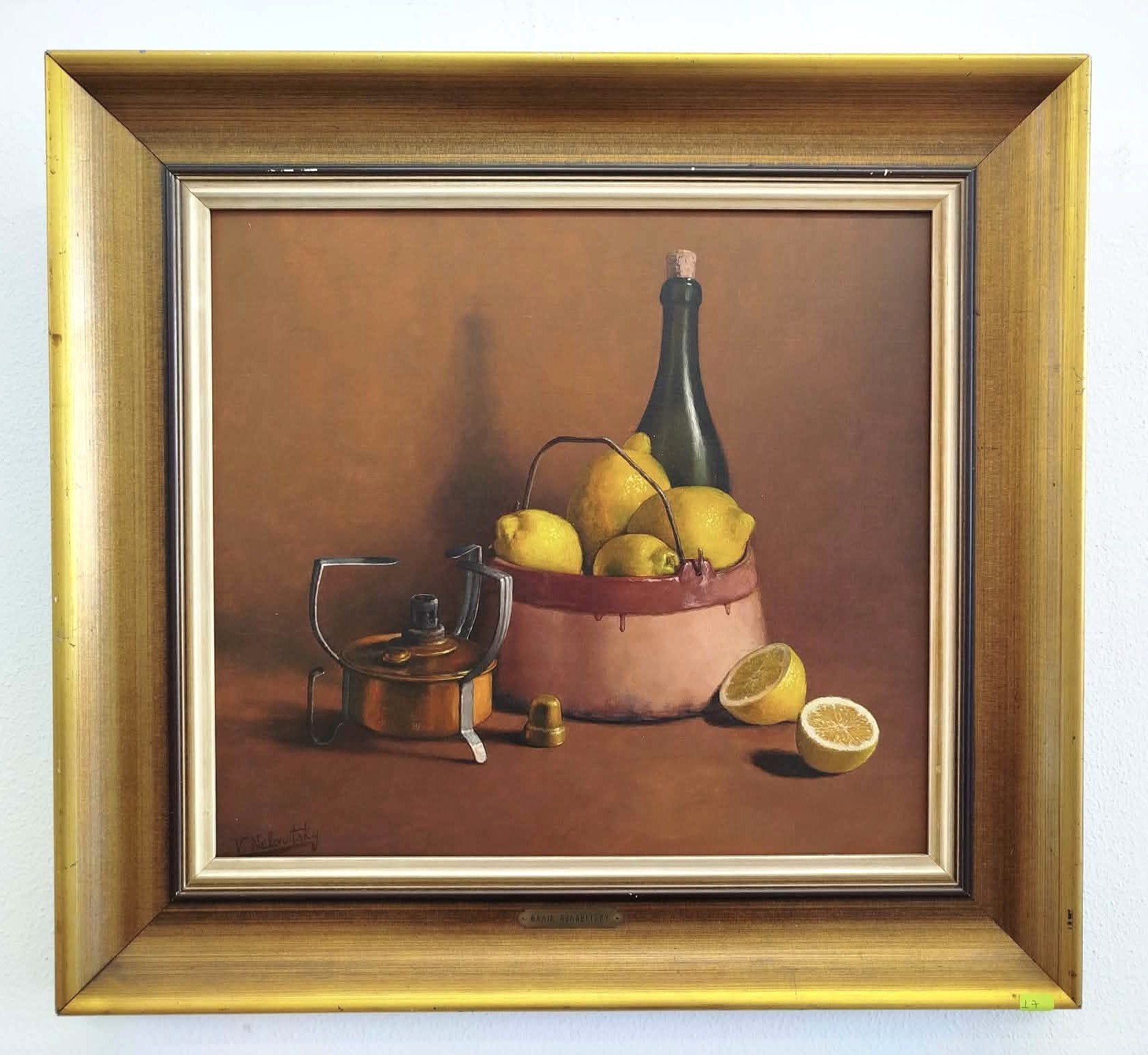
Still Life – Valia Nelavitksy
SKU:
Dimensions: 66.5×62 (frame included)
Art:
Date:
Materials:
Construction:
Price:
2728.00 €
Description
The present painting comes from the private collection of an individual collector. It is framed and ready for display.
The proceeds from its sale will be donated to charitable purposes.
(From an exhibition of Valia Nelavitsky in Heraklion, Crete)
Born in Athens to a Russian father and a Greek mother, Valia Nelavitsky developed an interest in painting from an early age. Coming from a family with a strong artistic tradition—her great-grandmother was a painter, and among her close relatives was the sculptor Moustakas, creator of the statue of Alexander the Great in Thessaloniki—provided the foundation for her later dedication to the visual arts.
She studied at the Athens School of Fine Arts (1948–1951) under P. Mathiopoulos and G. Moralis, and continued her studies in Paris (1952–1953) and Rome (1954–1955).
Influenced by seventeenth-century Flemish painters such as Peter Paul Rubens and Anthony van Dyck, as well as by the Dutch tradition of still-life painting, Valia Nelavitsky emerged as a significant representative of Naturalism, focusing on the vivid and lifelike depiction of objects. Her work is distinguished by realistic precision and meticulous attention to detail, through which she developed a highly personal artistic language characterized by refinement, perfection, and idealization.
Fruits, harvests, books, and other symbols of life and intellectual endeavor take shape and come alive on her palette, engaging and delighting the viewer’s eye. Her subjects are drawn from nature, and her affection for it is expressed not only through her choice of fruits, flowers, bread, and wine—often arranged alongside objects of varying textures and materials such as copperware, wooden surfaces, glass vessels, and earthenware jugs—but also through the manner in which she renders them, revealing their unique beauty.
In her still lifes, nature remains vibrant, present, and fresh. Even when objects are removed from their natural environment and placed within an interior setting, they never lose their vitality.
At first glance, one might regard the still-life genre as conventional or outdated. Others might emphasize its primarily decorative function. Yet a closer examination of Nelavitsky’s paintings reveals not only a rich and carefully crafted pictorial surface, but also an inner depth that extends beyond the faithful rendering of a beautiful image. Through her personal vision and painterly expression, she recreates reality in a way that invites deeper engagement.
From the critical responses her work has received over the years, Valia Nelavitsky has been recognized as a successful naturalist painter. However, she is much more than that. Her narrative sensibility, combined with her descriptive skill, draws the viewer into the artwork and offers multiple layers of interpretation. This, ultimately, ensures a balanced communicative relationship between the artist, the work of art, and the viewer—a principle central to the theory of reception.
Dimitra Sarri
Department of Art History, University of Crete.